
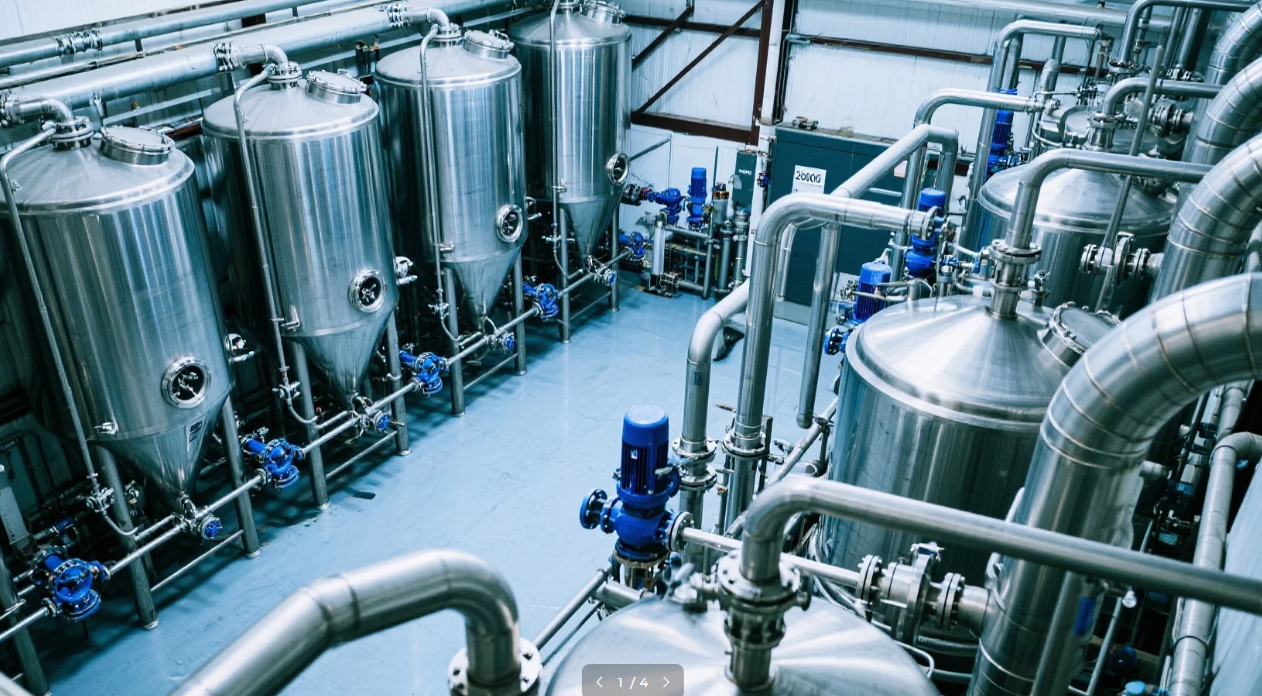
When a brewery scales up to 2000 liters, the initial instinct is to celebrate the extra capacity. But raw volume does nothing on its own. I have watched brewers install a 2000L brewery system only to discover that their output barely improved because every step between mash and bright tank had a hidden friction point. The equipment produces wort, but the system produces beer — and the gap between those two statements determines whether that 2000L investment pays off or just fills floor space.
A 2000L brewery system that operates efficiently produces predictable batches, minimizes idle time between brews, and keeps a compact team from being stretched thin. Efficiency at this scale is not about pushing the brewhouse harder. It is about designing every component and workflow so that the natural rhythm of the day — mash in, sparge, boil, transfer, cool, clean — runs without repeated intervention. When that works, a 2000L brewery system can support two brews per day with a team of two to three people, and the cellar turns over on schedule rather than creating a logjam that ruins the packaging plan.
The Brewhouse Concept: Where Efficiency Begins
The vessel layout of a 2000L brewery system is the single biggest determinant of how smoothly brew days go. The most common and reliable arrangement for this volume is a two-vessel setup: a combined mash-lauter tun and a combined kettle-whirlpool. That configuration keeps capital expenditure manageable while still allowing a repeatable process flow.
I have seen breweries try a three- or four-vessel system at this scale, and the added complexity rarely paid off — more vessels meant more piping, more valves, more cleaning circuits, and more points of failure for a team that does not have the headcount to babysit everything.
A well-designed mash-lauter tun makes the difference between a predictable eight-hour brew day and a twelve-hour ordeal. The false bottom must be sturdy enough to support the grain bed without sagging, and the slots need to be cut precisely so lautering runs clear without channeling.
I recall a brewery that skimped on the false bottom design and spent the first three months dealing with stuck mashes every fourth batch. They eventually replaced the false bottom with a thicker, laser-cut plate, and lautering time dropped by around 25 minutes per brew. That added up to nearly two hours of recovery per week just from one component.
The sparging system matters just as much. A rotating spray head that distributes hot water evenly across the grain bed prevents channeling and ensures sugar extraction is complete before the runoff finishes.
If the sparging arm is poorly positioned or the flow rate is not matched to the lauter tun diameter, you end up with low efficiency numbers and inconsistent gravity from batch to batch. That inconsistency then cascades into fermentation — underpitching, off-flavors, or extended conditioning times that delay tank turnover.
On the hot side, the kettle-whirlpool vessel needs geometry that supports a stable boil and a tight trub cone. A shallow, wide kettle creates more surface area for evaporation but can produce weaker whirlpool separation because the tangential velocity dissipates too quickly. A deeper, narrower vessel improves trub compaction but may require a longer boil to reach the desired evaporation rate.
At 2000L, a height-to-diameter ratio around 1.2:1 tends to strike the right balance. The heat exchanger sizing is also critical — an undersized plate exchanger can push cooling times past 60 minutes, which ties up the brewhouse and reduces the number of daily brews you can run. A correctly sized heat exchanger for 2000L should bring wort from boil temperature to pitching temperature in 25 to 35 minutes.
Pumps and piping are often treated as an afterthought, but they are the circulatory system of the brewhouse. A centrifugal pump matched to the viscosity of hot wort and the head height of the grain bed prevents cavitation and keeps transfers predictable.
Piping diameters that are too narrow create excessive back pressure and slow down transfers; diameters that are too wide increase cleaning volume and waste. For 2000L, 1.5-inch tri-clamp piping on the hot side and 2-inch on the cold side is a common and practical choice.
Capacity Planning: Making the Most of a 2000L Brewery System
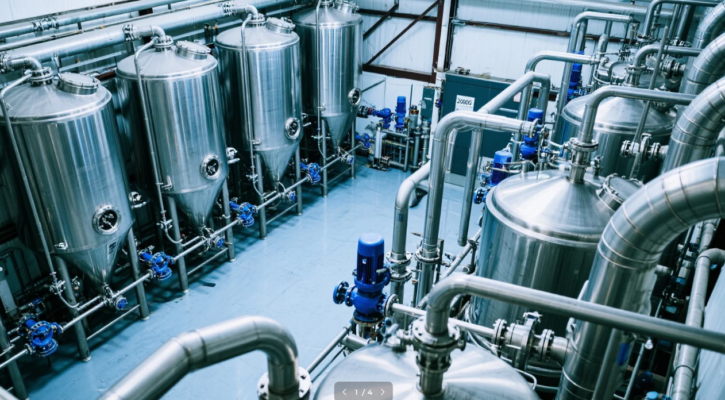
A 2000L brewery system can produce wort faster than the cellar can process beer if the tank count is wrong. I have walked into breweries that installed the brewhouse and then added fermenters one at a time as cash flow allowed. The result was a brewhouse that operated two days a week because there was nowhere to put the beer. Capacity planning is not glamorous, but it is the difference between a brewhouse that feels productive and one that feels wasteful.
The first question is brew frequency. If you plan to brew twice a day, five days a week, that is 20,000L of wort per week. A typical lager requires three to four weeks of fermentation and conditioning, which ties up tanks for that duration. If each fermenter holds exactly 2000L, you need at least 15 fermenters to keep that brew schedule running without overflow — and that is before accounting for cleaning downtime and conditioning variability. Most breweries at this scale run a more moderate schedule: one to two brews per day, three to four days per week, with the rest of the week reserved for packaging, cleaning, and maintenance.
Matching fermenter count to demand means thinking about batch-to-batch variability. If you brew a pale ale that finishes fermentation in seven days and conditions for another three, you can turn that tank in about twelve days including cleaning. A stout with a higher gravity may need fourteen days of fermentation and two weeks of conditioning. The cellar schedule needs to accommodate both without forcing a beer to sit in the bright tank for days waiting for a packaging slot. I have seen breweries hold beer in bright tanks for over a week because the packaging line was booked solid — that ties up a tank that could have been cleaned and refilled.
Bright beer tank availability is often the hidden constraint. Many breweries calculate fermenter count carefully but underestimate the number of bright tanks needed. If you have only two bright tanks and you brew four different beers in rotation, you end up with bright tanks occupied by beer that is waiting to be packaged while the next batch finishes conditioning in the fermenter. That creates a gap where the brewhouse cannot produce because there is no empty tank downstream. A good rule of thumb is to have at least one bright tank for every two to three fermentation tanks, depending on packaging frequency.
Packaging days should align with bright beer tank availability. If you package every Friday, the bright tanks need to be empty and ready by Thursday evening so that transfers can happen. That means the last brew of the week needs to be conditioned and crashed early enough to clear the fermenter and fill the bright tank before the packaging window closes. A common operational failure is brewing a high-gravity beer late in the week and then discovering it does not drop bright in time for packaging, forcing a delay that ripples into the following week’s brew schedule.
Layout and Workflow: Designing for Daily Productivity
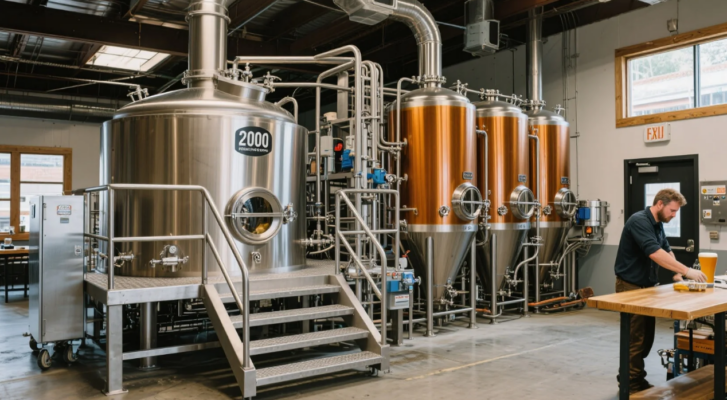
The physical arrangement of a 2000L brewery system influences productivity more than most brewers anticipate at the design stage. I have worked in breweries where the brewhouse was positioned at one end of the building and the fermenters at the other, with a long hose run in between. Every transfer required dragging a hose across the floor, connecting and disconnecting, and then cleaning it afterward. That added fifteen to twenty minutes to every transfer, which over a week of brewing consumed two to three hours of labor that could have been used for something else.
Short, clear product paths mean the brewhouse is located as close as possible to the fermentation cellar. Wort should leave the heat exchanger and enter the fermenter with minimal piping distance — ideally within five to ten meters. Fermenters should be positioned so that gravity transfer to bright tanks is possible, or at least so that the pump run is short. Bright tanks should sit near the packaging area so that filling kegs or bottles does not require another long hose run. When a breweries layout forces multiple hose changes per transfer, daily setup time can increase by 30 to 45 minutes.
Platforms and walkways are not just safety features — they affect how efficiently a team works. A platform that gives the brewer direct access to the top of the mash-lauter tun for grain-out and cleaning, without climbing stairs or reaching awkwardly, cuts grain-out time significantly. At 2000L brewery system, the grain-out door is heavy, and the spent grain needs to be removed manually or with a conveyor. If the platform is too low or the door is positioned at an uncomfortable angle, the brewer ends up fighting the equipment rather than working with it. I have seen breweries add a simple waist-high platform and reduce grain-out time by ten minutes per brew.
CIP lines are another layout element that gets overlooked. If the CIP system requires the brewer to manually connect hoses to every vessel and section of piping, cleaning becomes a slow, labor-intensive process that cuts into brew days. A dedicated CIP line with fixed connections to each tank and to the brewhouse piping circuit allows the brewer to start a cleaning cycle and walk away. That frees up time for other tasks and ensures cleaning happens consistently rather than being postponed because it is too much trouble. Breweries that invest in thorough CIP circuit design reduce downtime by 20 to 30 percent compared to those that rely on ad-hoc hose connections.
Utility distribution also matters. Cooling lines to fermenters should be laid out in a loop so that each tank gets consistent glycol pressure, not just the ones closest to the chiller. Power outlets for pumps and valves should be positioned where they are actually needed, not clustered in one corner. Floor drains need to be located under every vessel and along every hose path so that water and cleaning chemicals drain away quickly rather than pooling on the floor. That sounds trivial, but a wet, slippery floor slows down every task and creates safety hazards that interrupt the workflow.
Cleaning and Changeover: The Hidden Engine of Efficiency
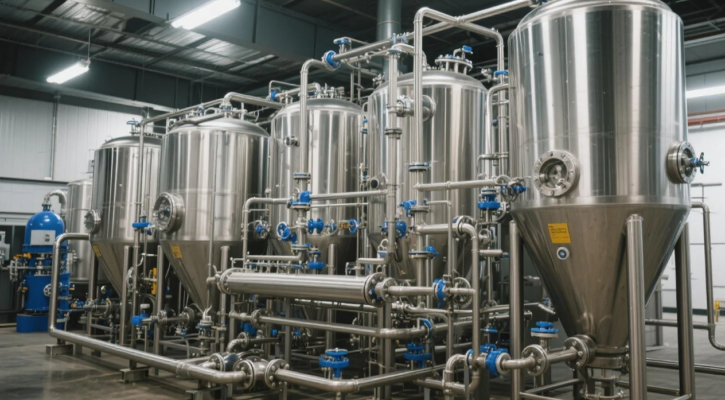
The most underestimated driver of throughput in a 2000L brewery system is cleaning efficiency. Brewers spend hours every week circulating caustic and acid through vessels and piping, and that time directly subtracts from available brewing hours. If a cleaning cycle takes three hours and you have five vessels to clean per week, that is fifteen hours of non-productive time. Optimizing that process can recover a full brew day each week without spending a dollar on new equipment.
The CIP system design determines how fast cleaning happens. A fixed spray ball in each vessel, with a pump that delivers the correct flow rate and pressure, ensures that every internal surface gets contacted by the cleaning solution. If the spray ball is undersized or positioned incorrectly, there will be dead zones where soil accumulates, requiring manual scrubbing that adds another hour per vessel. I have seen breweries install a properly sized spray ball and cut manual cleaning time by 80 percent.
Changeover procedures between batches — switching from one beer style to another — also affect efficiency. If you brew a heavily hopped IPA followed by a clean lager, the hop oils and polyphenols left in the brewhouse piping can carry over and taint the next batch. That means the piping between the kettle and the heat exchanger, and between the heat exchanger and the fermenter, must be cleaned between brews. A well-designed cleaning circuit with automated valves allows a hot rinse and caustic cycle to run in under an hour. Without that, the brewer has to disassulate tri-clamp fittings and manually scrub sections of pipe, which can stretch changeover to two hours or more.
Gaskets and valves are the weak points in any cleaning circuit. Gaskets that are old or improperly seated create crevices where microorganisms hide. Valves that are not designed for CIP — especially butterfly valves without a cleaning slot — trap soil in the stem area and require manual disassembly. Replacing standard gaskets with CIP-compatible gaskets and upgrading to valves that can be cleaned in place eliminates those hidden contamination sources and reduces the frequency of full manual teardowns.
One brewery I worked with tracked their cleaning time over three months and found that they spent an average of 6.5 hours per week on manual scrubbing and hose reconnections. They redesigned their CIP circuits, installed dedicated return lines, and replaced a handful of valves. Cleaning time dropped to 3.2 hours per week, and they gained an extra brew day every other week. That kind of gain does not come from a bigger brewhouse — it comes from treating cleaning as a production step rather than an afterthought.
The temptation to over-automate a 2000L brewery system is real. I have seen breweries spend heavily on automated valves, PLC-controlled brewhouse sequences, and remote monitoring systems, only to discover that the core processes — mash efficiency, lautering speed, cleaning consistency — were still mediocre. Automation at this scale adds cost and maintenance burden without proportional efficiency gains if the fundamentals are not solid. A manually operated brewhouse with well-designed vessels, logical layout, and disciplined cleaning routines will outperform a partially automated system with poorly thought-out components every time.

FAQ
What is the most important factor for efficiency in a 2000L brewhouse?
The brewhouse concept itself — specifically the vessel arrangement and component quality. A mash-lauter tun with a durable false bottom and effective sparging design, combined with a kettle-whirlpool that provides stable separation, directly determines whether brew days run smoothly or encounter repeated delays. Equipment built for predictable repeatability matters more than automation or fancy controls.
How many fermenters should accompany a 2000Lbrewery system?
For a moderate schedule of two brews per day, three to four days per week, you need at least six to eight fermenters of matching volume, plus two bright tanks. That accounts for fermentation timelines of one to four weeks depending on beer style and allows for cleaning downtime. Lager-focused breweries need more tanks due to longer conditioning periods.
Can a 2000L system be efficient without full automation?
Yes, and in many cases it is preferable. A manually operated brewhouse with well-designed layout, reliable equipment, and disciplined cleaning procedures can produce consistent results with a compact team. Full automation adds complexity, higher maintenance costs, and a steep learning curve without proportional throughput gains if the underlying process is sound.
How does layout affect cleaning time and throughput?
Poor layout forces frequent hose changes and long transfer runs, which adds 30 to 45 minutes of setup time per day. Fixed CIP lines with dedicated connections to each vessel eliminate most manual cleaning effort and can reduce total cleaning time by 30 to 50 percent. A logical floor plan translates directly into more brewing hours per week.
What is the most common mistake when scaling to a 2000L brewery system setup?
Underestimating the cellar requirement. Brewers focus on the brewhouse and neglect fermenter count, bright tank capacity, and packaging alignment. The result is a brewhouse that produces wort faster than the cellar can handle, forcing reduced brew frequency and idle equipment. Planning the entire production line — from brewhouse to packaging — before purchasing the brewhouse avoids that bottleneck.
