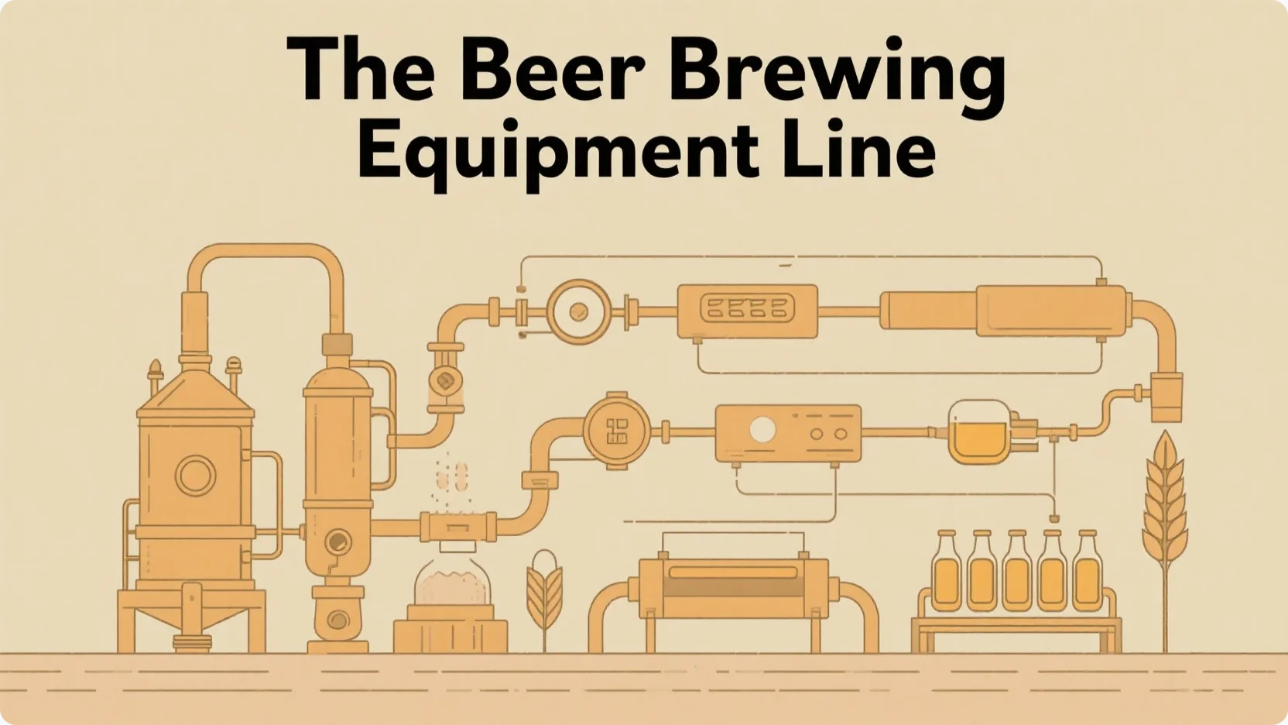
Modern industrial beer production has moved far beyond the image of a brewer stirring a copper kettle by hand. Today, from the moment malt enters the mill to the second a filled bottle exits the conveyor, every step depends on specialized equipment operating as an integrated line. Each station brewing equipment line — mashing, fermentation, cleaning, packaging — serves a specific function, and the real operational challenge is making sure they work together without creating bottlenecks that degrade quality or throughput. Understanding how these components fit into a complete system matters more than knowing any single piece of equipment in isolation.
A standard brewing line proceeds through four core stages. The mashing system converts raw grain into fermentable wort. The fermentation system transforms that wort into beer through controlled biochemical activity. The CIP system keeps every vessel and pipe clean without manual disassembly. And the filling and packaging line gets the finished product into containers ready for distribution. Each stage introduces its own constraints, and equipment choices at one stage ripple through the rest of the brewing equipment line.
The Mashing System – Where Wort Takes Shape
The mashing system is where everything begins, and it is also the most energy-intensive stage in the entire brewing line. Its job is to break down starches and proteins in malted barley into fermentable sugars and soluble flavor compounds using controlled heat and enzymatic activity. If this stage is done poorly, no amount of fermentation expertise or packaging precision will salvage the final beer.
The system consists of several discrete vessels, each handling a specific step in the sequence. A malt mill crushes dried malt kernels to expose the internal starch, typically operating at a capacity of 300–1000 kg per hour with adjustable crushing fineness. The crushed grist then moves into the mash tun, where it is mixed with hot water and held at specific temperature rests to activate beta-amylase and alpha-amylase enzymes. Temperature control here is not optional — a drift of even a couple of degrees can shift the fermentable sugar profile and alter the final alcohol content and body.
After mashing, the liquid is transferred to the lauter tun, where the spent grain husks form a natural filter bed. Clear wort drains through the false bottom while the solids remain behind. The wort then moves to the boiling kettle, where it is sterilized and hops are added for bitterness and aroma. Finally, the whirlpool uses centrifugal force to separate protein coagulates and hop residues from the hot wort before it moves to cooling.
What makes a modern mashing system operationally demanding is the interdependence of these vessels. An undersized heat recovery unit on the kettle, for example, means the next batch waits longer to reach pitching temperature. That delay compounds across a production day, reducing throughput and sometimes forcing operators to rush temperature rests in the mash tun to stay on schedule — a compromise that directly affects fermentability.
System features worth paying attention to include multi-point temperature control with automatic stirring, level indicators on each vessel, and a recipe control module that logs time, temperature, and volume data for traceability. The control module also supports recipe input, so different beer styles can be produced without manually recalculating every parameter.
One brewery the author worked with installed a 50 HL mash tun but paired it with a heat recovery system sized for 30 HL throughput. The result was a persistent 45-minute delay between batches during peak production, and the fermentation team constantly dealt with inconsistent starting gravity readings because the mash schedule kept getting compressed. The heat recovery upgrade, when it finally happened, cost roughly a third of what the original system did, but the lost production over two years far exceeded that figure.
| Equipment Name | Function | Typical Capacity | Notes |
|---|---|---|---|
| Malt Mill | Malt crushing | 300–1000 kg/h | Adjustable crushing fineness |
| Mash Tun | Mashing enzyme activation | 5HL–50HL | Stirring and temperature control |
| Lauter Tun | Wort filtration | Same as mash tun | With false bottom and lifting arms |
| Boiling Kettle | Wort boiling and hop addition | 5HL–50HL | Stainless steel steam heating |
| Whirlpool | Residue separation | 5HL–50HL | Bottom sediment outlet |
| Plate Heat Exchanger | Wort cooling | 5–20 m² | Multi-stage heat exchange |
| Fermenter | Fermentation | Varies | Temperature controlled, conical bottom |
The Fermentation System – The Core Biochemical Stage
Once the wort leaves the whirlpool, it passes through a plate heat exchanger that drops its temperature from near boiling to the yeast pitching range of 8–22°C, depending on the beer style. This cooling step is deceptively simple in description but operationally finicky — a heat exchanger with insufficient surface area (below 5 m² for most mid-scale lines) cannot achieve consistent outlet temperatures when flow rates fluctuate, and inconsistent pitching temperature stresses the yeast before fermentation even begins.
The fermentation system centers on the fermenter, a sealed, temperature-controlled pressure vessel with a conical bottom. The cone shape is not an aesthetic detail; it allows yeast and protein sediment to settle and be drained off without opening the tank, which would expose the beer to oxygen and contamination risk. During active fermentation, the yeast converts sugars into alcohol and CO₂, and the vessel must handle internal pressure from CO₂ buildup. Most tanks include an exhaust valve and an independent temperature control jacket that circulates coolant to keep the beer within a narrow temperature band.
After primary fermentation, the beer is typically transferred to a brite tank for conditioning and carbonation adjustment. The brite tank operates at lower temperatures — often near freezing — to allow remaining suspended solids to settle and to let the beer absorb CO₂ to the target carbonation level. Some lines also incorporate a yeast handling system that recovers yeast from the cone of the fermenter for repitching in subsequent batches, which reduces input costs but requires careful monitoring of yeast viability and contamination.
The fermentation stage is where the margin for error narrows considerably. A temperature spike of 3°C during active fermentation can produce excessive esters or fusel alcohols that give the beer a solvent-like character. Once those compounds are present, there is no practical way to remove them. The equipment must hold its setpoint reliably, and the cooling system — typically a glycol chiller loop — needs to be sized to handle worst-case heat loads, not average ones.
The CIP System – Hygiene Without Disassembly
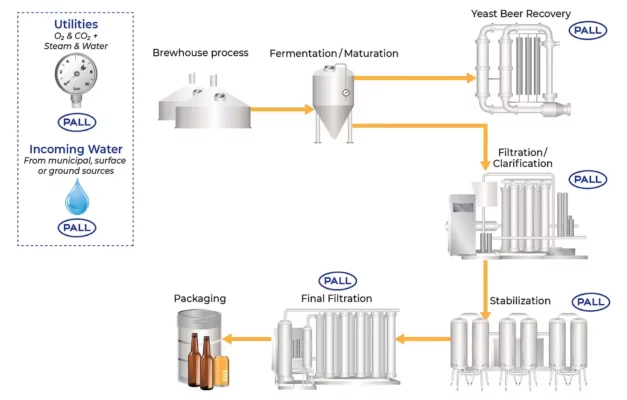
Of all the subsystems in a brewery, the Clean-in-Place (CIP) system is the one that operators tend to think about last, and it is also the one that silently determines whether every other piece of equipment functions correctly. A line that produces excellent wort but runs it through a dirty heat exchanger or a contaminated fermenter will produce off-flavored beer, and the source of the problem can be maddeningly difficult to trace.
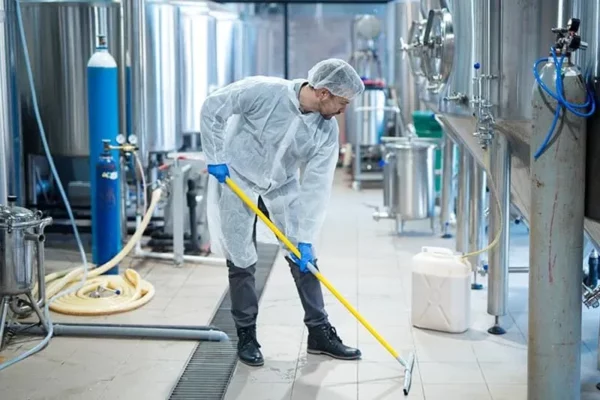
The CIP system cleans the internal surfaces of tanks, pipes, heat exchangers, and fillers without requiring any disassembly. It circulates cleaning solutions through the equipment in a programmed sequence: typically a caustic solution to dissolve organic residues, followed by an acid rinse to remove mineral scale, and finally a clean water rinse. Each solution is held in its own tank — caustic tank, acid tank, water tank — and a pump set drives the cleaning loop while a return system brings the spent solution back for recirculation or disposal.
Spray balls installed inside each vessel ensure that the cleaning solution reaches every interior surface. The system controls time, concentration, and temperature automatically, and modern CIP skids include real-time monitoring of flow rate, pH, and temperature. If any parameter falls outside the programmed range — say, the caustic temperature drops below 70°C — the system can pause the cycle and alert the operator.
The non-obvious reality of CIP is that a system sized just barely to meet minimum requirements often fails during heavy production cycles. When a brewery runs multiple batches in a day, the CIP system must keep pace. If the caustic tank is too small or the pump undersized, cleaning cycles take longer than the production schedule allows, and operators face a choice: run the next batch through a tank that has not completed its full rinse, or stop production. Neither option is good.
A case in point: a 15 HL brewery installed a CIP skid with a single 100-liter caustic tank. On a four-batch day, the caustic solution became saturated with organic residue by the third cleaning cycle and lost effectiveness. The team did not notice until the fourth batch developed a recurring phenolic off-flavor. Tracing the problem back to insufficient CIP capacity took three weeks and involved swapping yeast cultures, checking water chemistry, and eventually pulling apart a fermenter to find biofilm in the cone. The CIP upgrade cost was small relative to the lost product and troubleshooting hours.
The Filling and Packaging System – From Tank to Customer
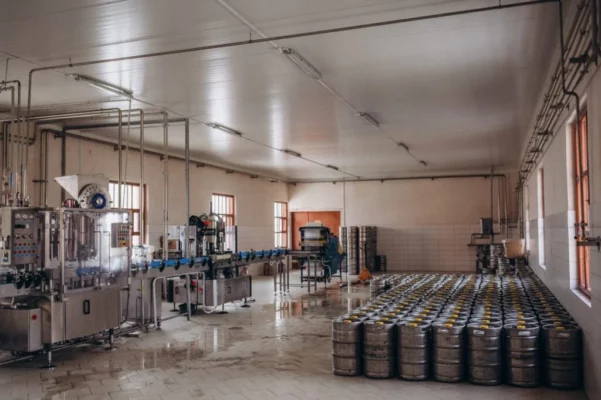
After fermentation and conditioning, the beer moves to the brite tank for final carbonation adjustment and then to the filler. The filling and packaging line is where the brewery’s entire production effort meets the market, and any failure here — oxidation, underfills, leaking seals — turns finished beer into waste or customer complaints.
The filler uses either vacuum or isobaric filling methods. Isobaric filling is more common for carbonated beer because it pressurizes the container with CO₂ before filling, minimizing oxygen pickup and foam formation. CO₂ purging before filling is a standard feature on well-designed lines, and it directly affects shelf life. Beer that picks up more than 50–100 ppb of dissolved oxygen during packaging will stale noticeably faster, and no amount of careful mashing or fermentation can reverse that.
After filling, the capper seals the container, and the labeler applies brand and regulatory labels. The packaging conveyor line handles packing, boxing, and stacking, often with automated systems that integrate weight checks and leakage detection. Containers that fail the check are automatically rejected from the line. This in-line inspection is essential because it prevents a single faulty seal or underfill from reaching the customer.
The packaging line ties back to the full-system concept from the start of this article. A brewery can produce world-class beer in the mashing and fermentation stages, but if the filler cannot maintain consistent headspace oxygen levels, or the conveyor jams every third batch, the operational cost of those problems will dominate the brewery’s attention. Equipment choices in packaging are driven as much by throughput and changeover speed as by quality specifications, and the tradeoffs are often about whether to prioritize flexibility for multiple container types or raw speed for a single format.
FAQ
Q1: What is the most energy-intensive part of a brewing equipment line?
The mashing system consumes more energy than any other stage, primarily because of the heating required for the mash tun and boiling kettle. Steam generation for these vessels accounts for the majority of a brewery’s thermal energy use. Heat recovery systems that capture energy from the boiling kettle or hot wort can reduce this load significantly, but the capital cost of a properly sized heat exchanger means many breweries underinvest in this area during initial setup.
Q2: Why does a fermenter need a conical bottom design?
The conical bottom allows yeast and trub (sediment) to settle and be collected at the lowest point of the tank. This makes it possible to drain off the sediment without opening the vessel, which avoids oxygen exposure and contamination risk. Without the cone, operators would need to transfer the beer to another tank or manually open the fermenter to clean it, both of which introduce quality and safety issues.
Q3: What does a CIP system clean, and why can’t you just hose everything down?
A CIP system cleans the internal surfaces of tanks, pipes, heat exchangers, and fillers using a programmed sequence of caustic, acid, and rinse solutions circulated at controlled temperatures and flow rates. Hosing down equipment manually cannot reach internal surfaces, cannot maintain the chemical concentration needed to dissolve organic residue and mineral scale, and cannot be performed without disassembling the equipment. A CIP system covers every surface that touches the beer, including pipes and fittings that are inaccessible by hand.
Q4: How does a whirlpool remove impurities from wort?
The whirlpool vessel receives hot wort from the kettle at a tangential angle, creating a gentle rotational flow. The centrifugal force drives protein coagulates and hop particles toward the center and bottom of the vessel, where they settle into a compact cone. The clarified wort is then drawn off from an outlet near the side wall, leaving the sediment behind. The entire process takes about 20–30 minutes and requires no filtration media.
Q5: What is the difference between a mash tun and a lauter tun?
The mash tun is where crushed malt and water are mixed and heated to activate enzymes that convert starches into fermentable sugars. The lauter tun is where the resulting mash is filtered to separate the liquid wort from the spent grain solids. In some small-scale systems, a single vessel called a mash-lauter tun performs both functions, but dedicated vessels are preferred in larger lines because the temperature control and filtration requirements differ, and using separate tanks allows both steps to proceed simultaneously on different batches.
