
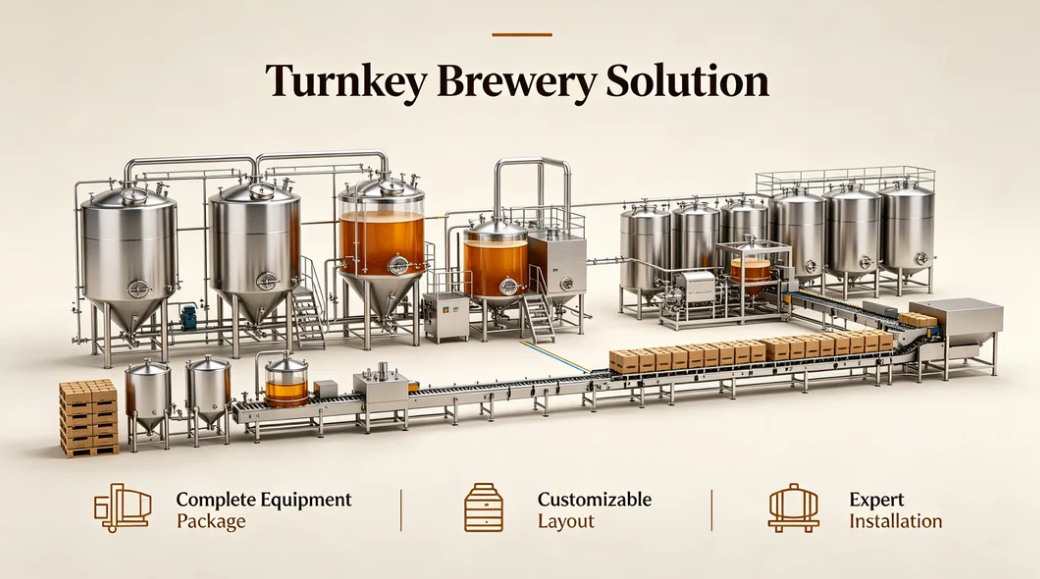
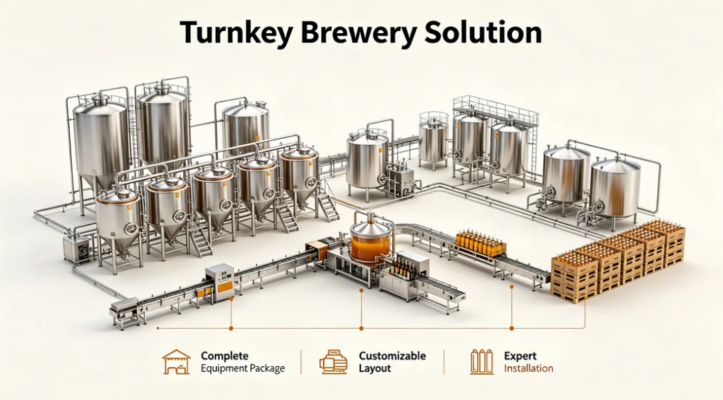
A Turnkey Brewery is the most efficient solution for investors who want to build a complete beer production facility with lower integration risks and faster startup time. Instead of purchasing individual machines from different suppliers, a turnkey brewery provides a complete system including brewhouse equipment, fermentation tanks, cooling systems, CIP cleaning, automation, packaging solutions, installation support, and commissioning. Choosing the right turnkey brewery supplier helps buyers reduce project delays, control costs, improve beer quality, and create a production system that can grow with future market demand.
What Does a Turnkey Brewery Actually Include?
A complete Turnkey Brewery includes all essential equipment and engineering services required to transform an empty space into a functional beer production facility.
Many new brewery investors misunderstand turnkey solutions as simply purchasing brewing tanks. In reality, a professional turnkey project integrates multiple systems that must work together.
A complete turnkey brewery usually includes:
- Malt handling system
- Brewhouse system
- Fermentation system
- Bright beer tanks
- Glycol cooling system
- CIP cleaning system
- Water treatment system
- Control system
- Beer transfer piping
- Packaging equipment
- Installation and commissioning
- Brewer training
The biggest advantage is that one supplier takes responsibility for system compatibility. This avoids problems caused by purchasing equipment separately from different manufacturers.
For example, tank dimensions, pump capacity, piping size, electrical controls, and cooling requirements must all match. A turnkey supplier designs these components as one integrated production system.
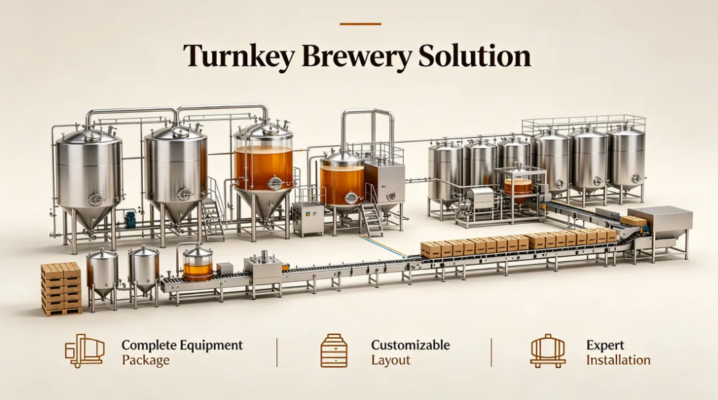
Why Should Buyers Choose a Turnkey Brewery Instead of Individual Equipment?
A Turnkey Brewery reduces project complexity by allowing buyers to work with one engineering partner instead of managing multiple equipment suppliers.
Building a brewery involves many technical decisions:
- What brewhouse size is suitable?
- How many fermentation tanks are required?
- What cooling capacity is needed?
- How should equipment be arranged?
- How should utilities be connected?
- What automation level is appropriate?
When equipment is purchased separately, buyers must coordinate different suppliers, which often creates installation conflicts and delays.
A turnkey brewery supplier can provide:
- Complete brewery layout design
- Equipment matching
- Utility planning
- Piping design
- Electrical integration
- Installation guidance
- Startup testing
This significantly reduces communication costs and helps breweries begin production faster.
What Equipment Is Included in a Complete Turnkey Brewery System?
A professional turnkey brewery combines hot-side brewing equipment, cold-side fermentation equipment, utilities, and packaging systems into one complete solution.
What Brewhouse Equipment Does a Turnkey Brewery Need?
The brewhouse determines brewing capacity and directly affects production efficiency.
The brewhouse is where raw materials are converted into wort through:
- Milling
- Mashing
- Lautering
- Boiling
- Whirlpooling
- Wort cooling
Common brewhouse configurations include:
| Brewhouse Type | Main Configuration | Advantages | Suitable For |
|---|---|---|---|
| 2 Vessel Brewhouse | Mash/Lauter + Kettle/Whirlpool | Lower investment, compact design | Brewpubs and small breweries |
| 3 Vessel Brewhouse | Mash Tun + Lauter Tun + Kettle/Whirlpool | Better efficiency and flexibility | Growing craft breweries |
| 4 Vessel Brewhouse | Separate mash, lauter, kettle, whirlpool | Higher output and process control | Commercial breweries |
A turnkey supplier should recommend the brewhouse configuration according to production goals rather than simply selling the largest system.
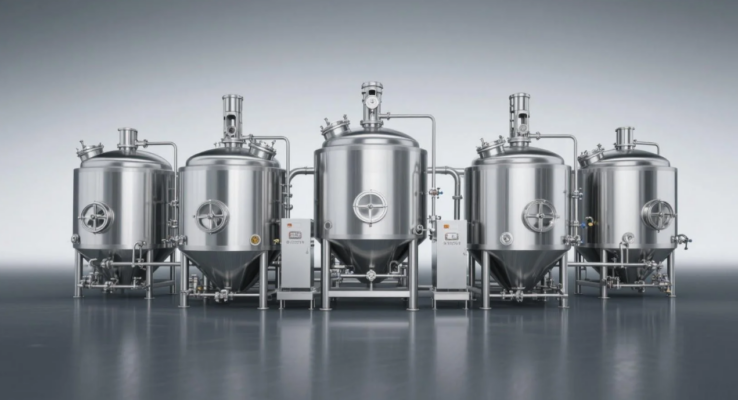
How Important Are Fermentation Tanks in a Turnkey Brewery?
Fermentation tanks are the core production equipment because they directly influence beer quality, production capacity, and scheduling efficiency.
Most turnkey breweries use stainless steel conical fermenters because they provide:
- Efficient yeast collection
- Temperature control
- Easy CIP cleaning
- Pressure fermentation capability
- Reduced contamination risk
Typical fermentation tank features include:
- SUS304 stainless steel construction
- Cooling jackets
- Pressure gauge
- Safety valve
- CIP spray ball
- Sampling valve
- Rotating racking arm
- Temperature sensor
The number of fermentation tanks determines how frequently a brewery can brew.
A larger brewhouse without enough fermentation capacity will still experience production bottlenecks.
What Is the Difference Between Fermenters and Brite Tanks?
Fermenters handle primary fermentation, while Brite Tanks prepare finished beer for carbonation, storage, and packaging.
Brite Tanks are essential for breweries that need:
- Stable carbonation
- Beer clarification
- Packaging preparation
- Short-term finished beer storage
The correct balance between fermenters and Brite Tanks improves production flow.
| Equipment | Function | Typical Features | Production Benefit |
|---|---|---|---|
| Fermentation Tank | Yeast fermentation | Cone bottom, glycol jacket, CIP | Improves fermentation control |
| Brite Tank | Conditioning and carbonation | Pressure rated, carbonation stone | Improves packaging efficiency |
| Unitank | Fermentation + conditioning | Combined vessel design | Saves space and reduces transfers |
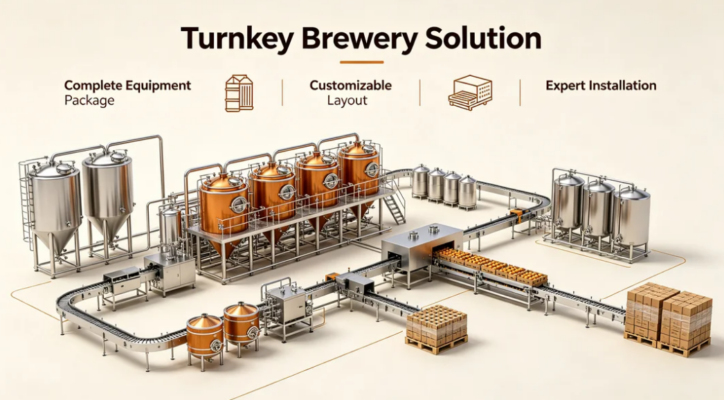
What Are the Typical Specifications of a Turnkey Brewery?
Turnkey brewery specifications should be selected according to production volume, available space, beer styles, and expansion plans.
Below is a common comparison:
| Brewery Scale | Brewhouse Size | Fermentation Tank Capacity | Application |
|---|---|---|---|
| Nano Brewery | 300L-1000L | 500L-2000L | Taproom and experimental brewing |
| Micro Brewery | 1000L-3000L | 1000L-6000L | Local craft beer production |
| Medium Brewery | 3000L-10000L | 5000L-20000L | Commercial distribution |
| Large Brewery | 10000L+ | 20000L+ | Industrial beer production |
The correct system is not always the biggest one. Oversized equipment can increase investment costs and reduce operational efficiency.
How Does Automation Improve a Turnkey Brewery?
Automation improves consistency, reduces labor requirements, and helps brewers control important production parameters.
Modern turnkey breweries may include:
- PLC control systems
- Automatic temperature control
- Pump control
- Fermentation monitoring
- CIP automation
- Data recording
Automation is especially valuable for breweries that want consistent beer quality across multiple batches.
However, automation level should match the brewery’s operational needs.
Small breweries may only need basic temperature control, while larger production facilities may require complete process automation.
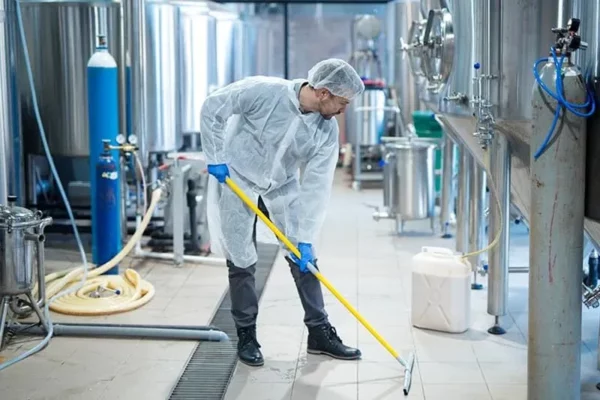
Why Is CIP Important in a Turnkey Brewery?
A professional CIP system improves sanitation efficiency and reduces production downtime.
Beer production requires strict hygiene control because microorganisms can affect flavor and stability.
A complete CIP system usually includes:
- Hot water tank
- Acid tank
- Alkali tank
- Cleaning pumps
- Spray devices
- Control cabinet
Benefits include:
- Faster tank cleaning
- Reduced labor costs
- Better sanitation
- Longer equipment lifespan
A turnkey supplier should include CIP planning during the initial brewery design rather than adding it later.
How Should Buyers Select the Right Turnkey Brewery Capacity?
The right brewery capacity should be calculated based on sales expectations, brewing frequency, beer styles, and future expansion plans.
Before purchasing, buyers should answer:
- How many liters of beer will be produced annually?
- How many brew days per week are planned?
- Which beer styles will be produced?
- How long is the fermentation period?
- Is packaging required?
For example:
A brewery mainly producing fast-fermenting ales may require fewer tanks than a brewery producing lager because lager requires longer fermentation and maturation time.
What Factors Should Buyers Evaluate When Choosing a Turnkey Brewery Supplier?
The supplier’s engineering ability is more important than equipment price alone.
A reliable turnkey brewery manufacturer should provide:
Engineering Capability
The supplier should offer:
- Brewery layout design
- Process design
- Tank drawings
- Utility calculation
- Installation guidance
Manufacturing Quality
Buyers should check:
- Stainless steel grade
- Welding quality
- Surface polishing
- Pressure testing
- Quality inspection procedures
After-Sales Support
A complete supplier should provide:
- Installation assistance
- Operator training
- Spare parts support
- Technical consultation
A turnkey project is a long-term partnership, not just a single equipment purchase.
How Much Does a Turnkey Brewery Cost?
The cost of a turnkey brewery depends mainly on capacity, automation level, equipment configuration, and customization requirements.
Major cost factors include:
- Brewhouse size
- Number of fermentation tanks
- Stainless steel thickness
- Cooling system capacity
- Automation level
- Packaging equipment
- Installation requirements
A smaller craft brewery may focus on minimizing initial investment, while a commercial brewery should prioritize efficiency and scalability.
The cheapest quotation is not always the best choice because poor integration can create higher operating costs later.
What Mistakes Should Buyers Avoid When Purchasing a Turnkey Brewery?
Avoiding common purchasing mistakes helps buyers reduce risks and achieve faster production startup.
Choosing Equipment Before Defining Production Goals
The brewery design should start with business planning, not equipment selection.
Ignoring Future Expansion
A brewery should leave room for additional fermentation tanks and increased production.
Focusing Only on Equipment Price
Low-cost systems may lack proper engineering, documentation, or after-sales support.
Not Confirming Installation Requirements
Buyers should confirm:
- Power supply
- Drainage
- Water requirements
- Building space
- Ventilation
How Can a Turnkey Brewery Help New Breweries Start Faster?
A turnkey brewery shortens the journey from business planning to commercial beer production.
Instead of coordinating dozens of suppliers, buyers receive a complete production solution from one experienced partner.
The supplier manages:
- Equipment manufacturing
- System integration
- Installation coordination
- Testing
- Training
This allows brewery owners to focus more on:
- Recipe development
- Marketing
- Sales channels
- Brand building
For investors entering the beer industry, turnkey solutions provide a safer and more predictable path.
Frequently Asked Questions About Turnkey Brewery
1. What is a Turnkey Brewery?
A Turnkey Brewery is a complete beer production solution provided by one supplier, including brewing equipment, fermentation systems, utilities, automation, installation support, and commissioning.
2. What equipment is included in a Turnkey Brewery system?
A complete system usually includes brewhouse equipment, fermentation tanks, Brite Tanks, glycol cooling systems, CIP systems, control panels, piping, and optional packaging equipment.
3. Is a Turnkey Brewery suitable for small craft breweries?
Yes. Turnkey breweries can be customized from small nano brewery systems to large commercial production facilities according to budget, space, and production goals.
4. How long does it take to build a Turnkey Brewery?
The timeline depends on brewery size, customization level, manufacturing schedule, shipping, and installation requirements. Professional suppliers can provide a project schedule from design to startup.
Conclusion: How Should Buyers Choose a Turnkey Brewery?
Choosing the right Turnkey Brewery requires more than selecting equipment capacity. Buyers should evaluate system integration, production requirements, equipment quality, automation needs, and supplier experience.
A well-designed turnkey brewery provides a complete path from raw materials to finished beer, helping breweries reduce risk, improve efficiency, and build a scalable production foundation.
