
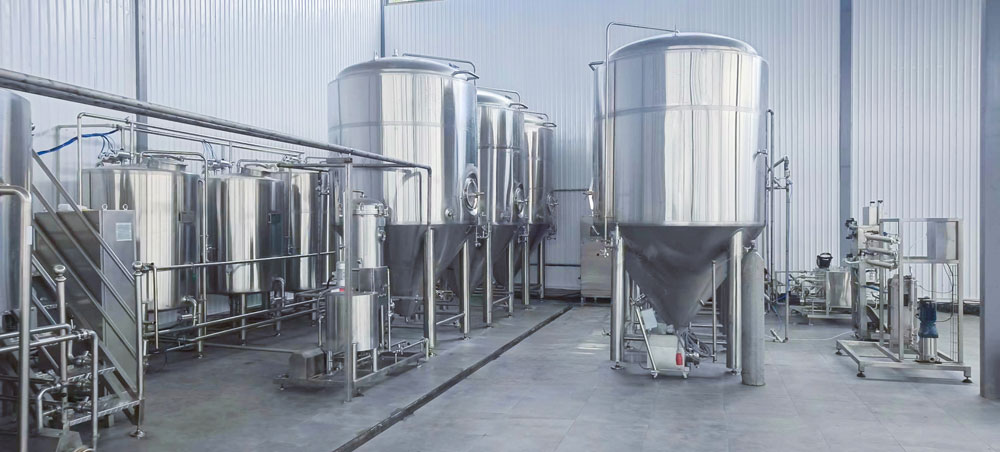
Commercial brewery equipment is the foundation of a successful large-scale brewing operation because it directly affects production capacity, beer consistency, operating costs, and future expansion. Choosing the right brewing system allows breweries to achieve stable fermentation, efficient workflow, lower labor requirements, and reliable product quality.
For investors planning a new brewery or expanding an existing facility, selecting professional commercial brewery equipment from an experienced manufacturer is one of the most important decisions for long-term profitability.
What Is Commercial Brewery Equipment and Why Is It Important for Modern Breweries?
Commercial brewery equipment is a complete production system designed for professional beer manufacturing rather than small-scale hobby brewing. It includes brewhouse systems, fermentation tanks, bright beer tanks, cooling systems, CIP cleaning systems, automation controls, and packaging equipment that work together to produce consistent beer at commercial volumes.
Unlike basic brewing setups, commercial systems are engineered for continuous operation, strict hygiene standards, and repeatable production. A brewery’s success depends not only on the quality of raw materials but also on how accurately the equipment controls temperature, pressure, sanitation, and processing time.
For commercial breweries, equipment selection influences:
- Daily production capacity
- Beer flavor consistency
- Energy and water consumption
- Labor efficiency
- Maintenance costs
- Expansion flexibility
A properly designed system helps breweries reduce production risks while creating a stable foundation for brand growth.
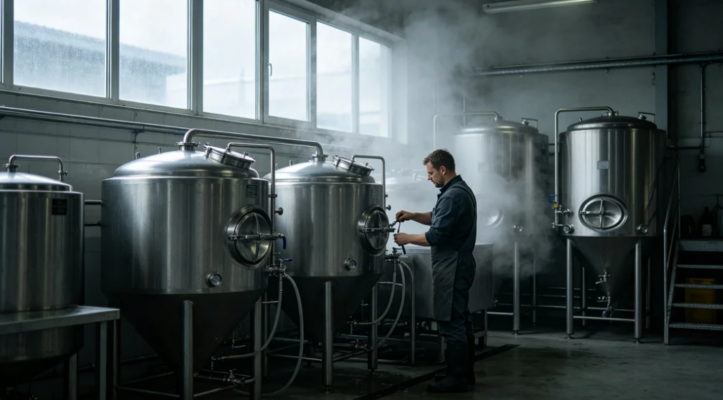
What Types of Commercial Brewery Equipment Are Required for a Complete Brewing System?
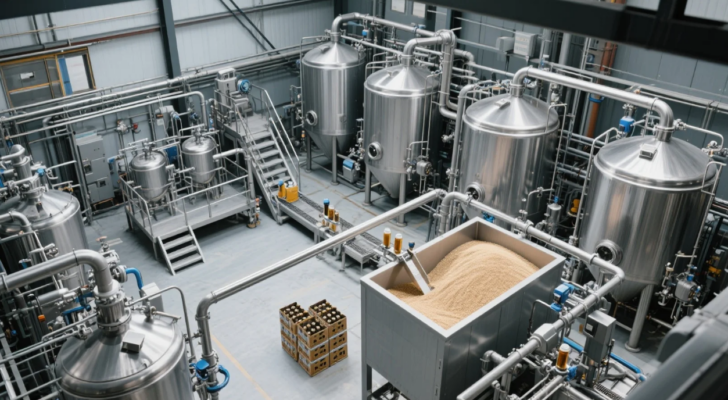
A complete commercial brewery requires multiple interconnected equipment sections because beer production involves several precise processing stages. A professional brewery is not built around a single machine but around an integrated production line that covers raw material handling, wort production, fermentation, conditioning, and packaging.
1. Malt Milling and Grain Handling System
The malt milling system prepares grains efficiently to ensure maximum extraction during brewing.
The milling process directly affects brewhouse efficiency because properly crushed malt improves sugar extraction while maintaining suitable grain husk structure for filtration.
Commercial milling equipment usually includes:
- Malt mills
- Grain conveyors
- Storage bins
- Dust collection systems
A reliable milling system reduces material waste and provides consistent grain preparation for every brewing batch.
2. Brewhouse System
The brewhouse is the core production area where raw ingredients are transformed into wort.
A commercial brewhouse normally includes:
- Mash tun
- Lauter tun
- Brew kettle
- Whirlpool tank
- Hot liquor tank
Different breweries select different configurations depending on production targets.
A 2-vessel brewhouse is suitable for smaller commercial breweries that need lower investment and simple operation. Larger breweries often choose 3-vessel or 4-vessel systems because they provide higher efficiency and greater production flexibility.
Commercial Brewhouse Configuration Comparison
| Brewhouse Type | Recommended Capacity | Main Features | Suitable Brewery Type |
|---|---|---|---|
| 2-Vessel Brewhouse | 5-20 BBL | Compact design, lower investment, easy operation | Brewpubs and small craft breweries |
| 3-Vessel Brewhouse | 20-50 BBL | Higher efficiency and flexible production | Growing commercial breweries |
| 4-Vessel Brewhouse | 50 BBL+ | Maximum throughput and automation options | Large commercial breweries |
The right brewhouse selection should consider current production demand and future expansion plans.
How Do Fermentation Tanks Improve Commercial Beer Production?
Fermentation tanks are essential because they control the transformation of wort into finished beer while maintaining consistent flavor and quality.
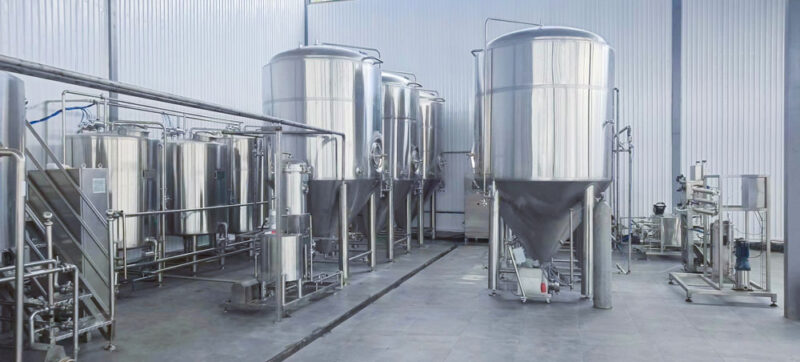
Commercial breweries typically use stainless steel conical fermentation tanks because they provide:
- Accurate temperature control
- Easy yeast collection
- Efficient cleaning
- Pressure fermentation capability
The number and size of fermentation tanks should match the brewhouse output. Insufficient fermentation capacity can create production bottlenecks even when the brewhouse has enough capacity.
Fermentation Equipment Comparison
| Equipment | Capacity Range | Function | Advantages |
|---|---|---|---|
| Unitank Fermenter | 5-200HL | Fermentation and conditioning | Saves space and improves efficiency |
| Bright Beer Tank | 5-200HL | Beer storage and carbonation | Improves packaging efficiency |
| Serving Tank | Small-Medium | Direct beer supply | Suitable for taprooms |
A balanced ratio between brewhouse capacity and fermentation volume allows breweries to maintain continuous production.
Why Are Cooling and Temperature Control Systems Critical for Commercial Breweries?
A professional cooling system ensures stable fermentation conditions and protects beer quality.
Temperature control is one of the most important factors in brewing because yeast performance depends heavily on fermentation temperature.
Commercial brewery cooling systems generally include:
- Glycol chillers
- Glycol storage tanks
- Pumps
- Cooling pipelines
- Tank cooling jackets
An undersized cooling system may cause slow fermentation, inconsistent flavors, and production delays.
A properly designed glycol system helps breweries:
- Maintain accurate fermentation temperatures
- Shorten cooling time
- Improve batch consistency
- Reduce energy waste
How Does a CIP System Improve Brewery Hygiene and Efficiency?
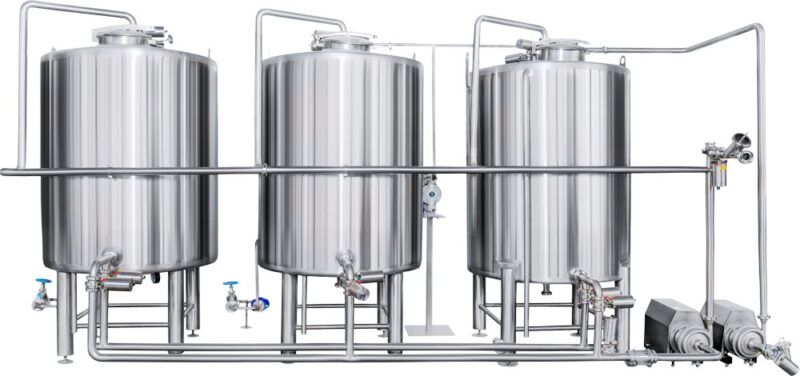
A CIP (Clean-In-Place) system improves sanitation efficiency by cleaning brewery equipment without requiring complete disassembly.
Clean equipment is essential for preventing contamination and maintaining stable beer quality.
A commercial CIP system usually contains:
- Cleaning tanks
- Pumps
- Heating systems
- Spray balls
- Chemical circulation pipelines
Compared with manual cleaning, automated CIP systems provide:
- Lower labor costs
- Faster cleaning cycles
- More consistent sanitation results
- Reduced contamination risks
For commercial breweries producing thousands of liters of beer every day, CIP automation becomes an important investment.
How Does Automation Improve Commercial Brewery Equipment Performance?
Automation systems help breweries increase accuracy, reduce labor dependence, and achieve repeatable production results.
Modern commercial brewery equipment can include:
- PLC control systems
- Touchscreen HMI interfaces
- Automatic valve control
- Temperature sensors
- Recipe management systems
Automation allows operators to monitor brewing parameters and maintain consistency between different batches.
Manual vs Automated Brewery Equipment Comparison
| Feature | Manual System | Automated System |
|---|---|---|
| Operation | Requires more labor | Reduced operator workload |
| Temperature Control | Manual adjustment | Automatic monitoring |
| Production Consistency | Depends on operator skills | Higher repeatability |
| Expansion Capability | Limited | Easier integration |
For breweries planning long-term growth, automation can significantly improve operational efficiency.
How Should Buyers Choose the Right Commercial Brewery Equipment?
The best commercial brewery equipment should match production goals, available space, budget, and future expansion plans. Buyers should evaluate more than equipment price because system design, manufacturing quality, installation support, and after-sales service directly influence long-term operating costs.
Before purchasing, breweries should consider:
Production Capacity Requirements
Calculate:
- Expected annual beer production
- Number of brewing days per week
- Target market demand
- Future expansion plans
Choosing oversized equipment increases investment costs, while undersized equipment limits growth.
Equipment Material and Manufacturing Quality
High-quality stainless steel construction improves equipment durability and sanitation performance.
Professional brewery equipment commonly uses:
- SUS304 stainless steel
- SUS316L stainless steel for higher corrosion resistance
- Food-grade sanitary fittings
- Polished internal surfaces
Manufacturing quality affects equipment lifespan and maintenance requirements.
Supplier Engineering Capability
A reliable supplier should provide complete brewery solutions rather than individual equipment only.
A professional manufacturer should support:
- Brewery layout design
- Equipment customization
- Installation guidance
- Commissioning
- Operator training
- Spare parts supply
A complete engineering approach reduces project risks and improves startup efficiency.
What Are the Main Advantages of Investing in Professional Commercial Brewery Equipment?
Professional commercial brewery equipment helps breweries achieve higher efficiency, better quality control, and stronger market competitiveness.
The main benefits include:
Improved Production Efficiency
Optimized equipment layouts reduce unnecessary transfers and shorten production cycles.
Consistent Beer Quality
Precise temperature, pressure, and sanitation control improve flavor stability.
Lower Operating Costs
Energy-efficient systems reduce water, labor, and maintenance expenses.
Easier Future Expansion
Modular equipment designs allow breweries to add fermentation tanks, packaging lines, or additional brewing capacity.
Conclusion: How Can Commercial Brewery Equipment Support Brewery Growth?
Commercial brewery equipment is not simply a collection of stainless steel tanks; it is a complete production solution that determines brewery efficiency, product quality, and future scalability. By selecting properly designed brewhouses, fermentation systems, cooling equipment, CIP systems, and automation solutions, breweries can build reliable operations capable of long-term growth.
For brewery investors and purchasing managers, working with an experienced commercial brewery equipment manufacturer is the key step toward creating an efficient and profitable beer production facility.
Frequently Asked Questions About Commercial Brewery Equipment
1. What equipment is included in a complete commercial brewery system?
A complete commercial brewery system usually includes a brewhouse, fermentation tanks, bright beer tanks, cooling system, CIP system, control system, and packaging equipment. The exact configuration depends on production capacity and brewery requirements.
2. How much does commercial brewery equipment cost?
The cost depends on brewery size, automation level, materials, production capacity, and customization requirements. Small commercial systems may require lower investment, while large automated brewery projects require significantly higher budgets.
3. What size commercial brewery equipment should I choose?
The correct size depends on expected beer production volume, market demand, available space, and expansion plans. A professional supplier can calculate the suitable brewhouse and fermentation capacity based on your business goals.
4. How long can commercial brewery equipment last?
High-quality stainless steel brewery equipment can typically operate for many years with proper maintenance. Regular cleaning, inspection, and replacement of wear parts help extend equipment service life.
