
Choosing the right Fermentation Tanks Manufacturer is essential for breweries that want stable fermentation, consistent beer quality, efficient cellar operations, and scalable production.
The right manufacturer should provide more than stainless steel tanks: buyers need suitable capacity, hygienic construction, cooling and temperature control, pressure management, customized fittings, professional engineering, installation, and long-term after-sales support. A good fermentation tank solution should also match the brewhouse output, fermentation cycle, available space, packaging schedule, and future expansion plans.
What Should Buyers Look for in a Fermentation Tanks Manufacturer?
The best Fermentation Tanks Manufacturer should be able to design the tank around the brewery’s production requirements instead of simply selling a standard vessel. Fermentation tanks are central to the beer production process, so their capacity, configuration, cooling performance, pressure rating, and sanitary design directly affect production efficiency.
A commercial brewery may use several fermentation tanks simultaneously for different beer styles and production batches. Therefore, purchasing decisions should consider the complete fermentation cellar rather than one tank at a time.
A qualified manufacturer should be able to help buyers evaluate:
- Required fermentation capacity
- Number of fermentation tanks
- Tank dimensions and installation space
- Stainless steel construction
- Cooling jacket configuration
- Working and total volume
- Operating pressure
- Sanitary fittings
- CIP requirements
- Temperature control
- Automation requirements
- Future expansion capacity
- Installation and commissioning
- Warranty and after-sales service
This approach allows the buyer to select a fermentation system that supports actual brewery production rather than simply purchasing tanks based on price.
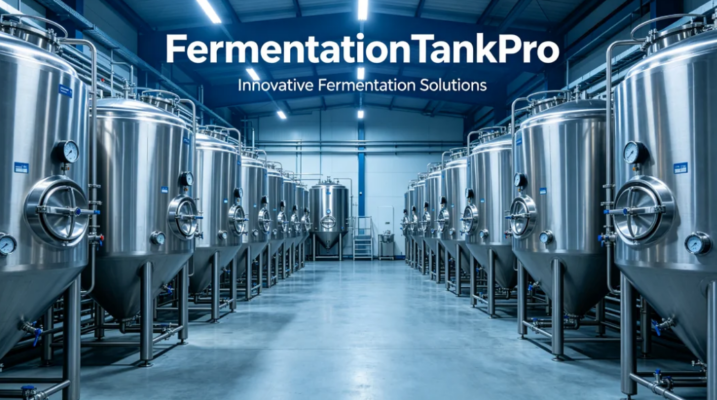
How Should Buyers Calculate Fermentation Tank Capacity?
Fermentation tank capacity should be calculated from brewhouse batch size, brewing frequency, fermentation time, conditioning time, and target production output. Choosing tank volume without considering the production schedule can create a bottleneck even when the brewhouse has sufficient capacity.
For example, a brewery may have a brewhouse capable of producing multiple batches per week, but if the cellar has insufficient fermentation capacity, wort production will eventually have to stop.
A basic planning method is:
Required Fermentation Capacity = Batch Volume × Number of Simultaneous Fermentation Batches
However, the calculation should also consider:
- Beer style
- Fermentation temperature
- Yeast characteristics
- Fermentation duration
- Conditioning time
- Cleaning time
- Tank turnover
- Seasonal demand
- Packaging frequency
- Future production growth
The source article from HGMC identifies commercial fermentation tank options ranging from 300L to 100,000L, including 300L, 500L, 1,000L, 2,000L, 5,000L, 10,000L, 30,000L, 50,000L, and 100,000L configurations. This broad range allows tank capacity and quantity to be planned around different brewery production scales.
Which Fermentation Tank Size Should Commercial Breweries Choose?
The appropriate fermentation tank size depends on production scale rather than a universal “best” capacity. Small breweries may benefit from several smaller tanks because they provide greater flexibility, while large commercial breweries may use larger vessels to reduce the number of tanks required for high-volume production.
The following table can be used as a preliminary purchasing reference:
| Fermentation Tank Size | Typical Application | Main Purchasing Advantage | Key Consideration |
|---|---|---|---|
| 300L | Pilot brewing, small batch, specialty beer | Flexible small-batch production | Higher tank quantity may be required |
| 500L | Small brewery, taproom, pilot commercial production | Flexible production and compact footprint | Calculate future expansion carefully |
| 1,000L | Microbrewery | Suitable for regular commercial production | Match tank size with brewhouse batch volume |
| 2,000L | Growing brewery | Larger batch capacity | Requires sufficient cooling capacity |
| 5,000L | Commercial brewery | Supports higher production volume | Building height and access must be checked |
| 10,000L | Medium/large brewery | Efficient fermentation at commercial scale | Utility and cooling demand increase |
| 30,000L | Large commercial production | High-volume fermentation | Requires professional cellar engineering |
| 50,000L | Large-scale brewery | High production efficiency | Significant infrastructure requirements |
| 100,000L | Industrial-scale brewing | Very high fermentation capacity | Requires comprehensive process engineering |
These figures represent equipment capacity categories rather than a recommendation for a specific brewery. Final selection should be based on the customer’s brewhouse output, fermentation cycle, beer portfolio, site conditions, utilities, and production forecast.
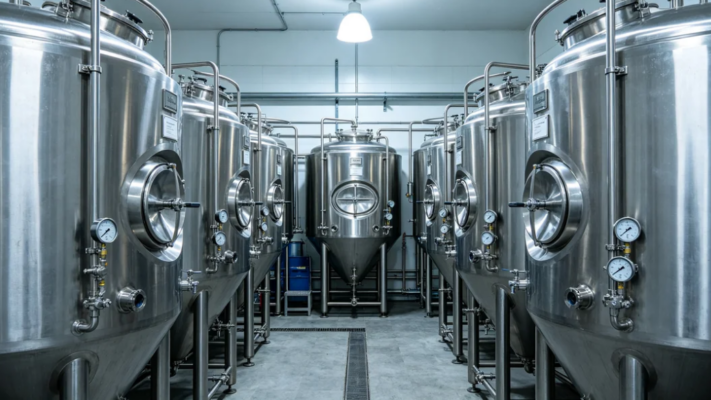
Why Is Stainless Steel Important When Choosing a Fermentation Tank?
Stainless steel is important because fermentation tanks must withstand repeated contact with wort, beer, cleaning chemicals, moisture, temperature changes, and pressure-related operating conditions. For commercial brewing, the material should be evaluated together with welding quality, internal surface finish, insulation, cooling jackets, fittings, and sanitary design.
Many commercial brewery fermentation tanks use stainless steel construction because the material can support hygienic production and repeated cleaning when properly fabricated and maintained.
However, buyers should not evaluate a tank solely by asking whether it is “stainless steel.”
A professional specification should also identify:
- Stainless steel grade
- Inner tank thickness
- Outer shell thickness
- Internal surface finish
- Welding method
- Welding quality
- Insulation structure
- Cooling jacket
- Sanitary fittings
- Pressure rating
- CIP configuration
For example, HGMC’s published 500L fermentation tank specification uses SUS304 stainless steel, with a 3.0 mm inner tank and 2.5 mm external thickness. The published model has a gross capacity of 670L, an external size of approximately Ø1060 × 2400 mm, and a weight of about 300 kg.
What Specifications Should Buyers Compare Between Fermentation Tanks Manufacturers?
Buyers should compare technical specifications rather than comparing supplier quotations by price alone. Two tanks with the same nominal volume may have different construction, fittings, cooling systems, insulation, automation, and pressure specifications.
Important specifications include:
Working Volume and Total Volume
Working volume determines usable production capacity, while total volume provides the necessary headspace for fermentation. Buyers should confirm both values before purchasing.
For example, a tank marketed as a “500L fermenter” may have a working volume of 500L but a substantially larger gross volume.
Tank Dimensions
Tank diameter and height must match the brewery building and cellar layout. A technically suitable tank may still be impractical if it cannot pass through the brewery entrance or fit beneath the available ceiling height.
Buyers should check:
- Tank diameter
- Tank height
- Manway position
- Access clearance
- Piping space
- Maintenance space
- Transportation route
Pressure Rating
Pressure specifications should be matched to the intended fermentation and conditioning process. Buyers should confirm working pressure, design pressure, safety valve configuration, and pressure gauge specifications with the manufacturer.
Cooling Configuration
Cooling performance should be evaluated according to tank volume and the brewery’s complete glycol system. A large number of fermenters can create a significant cooling demand, particularly when several tanks are fermenting simultaneously.
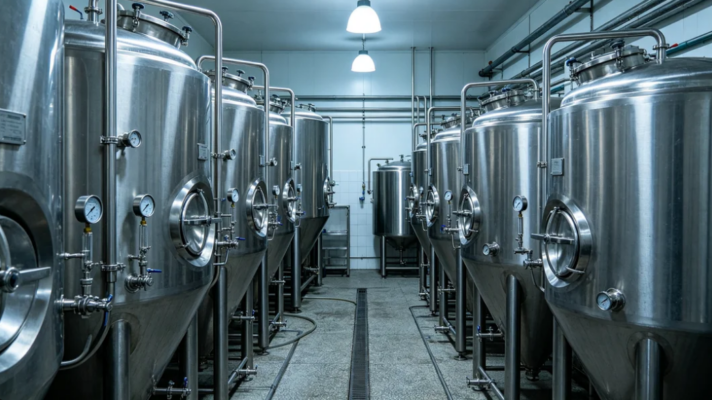
How Does a Fermentation Tank Cooling System Affect Brewery Production?
Reliable temperature control is one of the most important functions of a commercial fermentation tank. Fermentation temperature influences yeast activity, fermentation progress, beer characteristics, and production scheduling.
A typical commercial fermentation tank may use an external cooling jacket connected to a glycol cooling system.
The complete cooling system should consider:
- Number of fermenters
- Individual tank capacity
- Number of tanks operating simultaneously
- Target fermentation temperature
- Ambient temperature
- Glycol temperature
- Cooling load
- Heat transfer requirements
- Chiller capacity
- Future tank expansion
A manufacturer should therefore calculate fermentation cooling as part of the complete cellar design rather than treating every tank as an isolated product.
For breweries producing several beer styles at the same time, individual tank temperature control can also provide greater production flexibility. Different fermentation programs can be managed according to the beer being produced.
Can a Fermentation Tanks Manufacturer Customize Tanks for Different Breweries?
Customization is important because brewery buildings, production processes, beer styles, and utility conditions are rarely identical. A professional manufacturer should be able to adjust the tank configuration according to the customer’s actual requirements.
Possible customization areas include:
- Tank diameter
- Tank height
- Working volume
- Cooling jacket
- Manhole position
- Racking arm
- Sample valve
- Pressure gauge
- Safety valve
- CIP spray ball
- Butterfly valves
- Tri-clamp fittings
- Thermometer connection
- Filling connection
- Carbonation connection
- Hop port
- Temperature sensor
- Control system
Customization should have a practical purpose. Adding unnecessary components can increase cost and maintenance complexity without improving production.
The objective should be to create a fermentation vessel that fits the brewery’s process, layout, operating habits, and future requirements.
What Fermentation Tank Configuration Is Suitable for Different Brewery Sizes?
Small, medium, and large breweries require different fermentation strategies because their production schedules and cellar constraints are different.
What Should Small Breweries Consider?
Small breweries should prioritize flexibility and manageable investment. A combination of 300L, 500L, or 1,000L tanks may allow brewers to produce multiple beer styles without committing to very large vessels.
Smaller tanks can be particularly useful for:
- Taproom breweries
- Brewpubs
- Pilot production
- Seasonal beers
- Experimental recipes
- Specialty products
The trade-off is that more tanks may be required to reach higher annual production.
What Should Growing Breweries Consider?
Growing breweries should balance fermentation capacity with future production growth. A brewery that expects sales to increase should consider reserving space and utilities for additional fermenters.
For example, a brewery may initially install several 2,000L or 5,000L fermenters and later add additional tanks without redesigning the entire cellar.
What Should Large Breweries Consider?
Large breweries should prioritize production efficiency, cooling capacity, automation, and process integration. Larger fermentation tanks can reduce the number of vessels needed for high-volume production, but they require more careful engineering.
Tank transportation, installation, structural loading, cooling capacity, cleaning systems, piping, and maintenance access all become increasingly important.
How Should Buyers Compare Fermentation Tanks Manufacturer Quotations?
A proper quotation comparison should evaluate the complete project scope instead of comparing the tank price alone.
A useful purchasing comparison can include:
| Purchasing Factor | Supplier A | Supplier B | Supplier C |
|---|---|---|---|
| Tank Working Volume | Confirm | Confirm | Confirm |
| Gross Volume | Confirm | Confirm | Confirm |
| Stainless Steel Grade | Confirm | Confirm | Confirm |
| Inner Thickness | Confirm | Confirm | Confirm |
| Cooling Jacket | Confirm | Confirm | Confirm |
| Insulation | Confirm | Confirm | Confirm |
| Pressure Rating | Confirm | Confirm | Confirm |
| Sanitary Fittings | Confirm | Confirm | Confirm |
| CIP System | Confirm | Confirm | Confirm |
| Temperature Control | Confirm | Confirm | Confirm |
| Automation | Confirm | Confirm | Confirm |
| Installation | Confirm | Confirm | Confirm |
| Commissioning | Confirm | Confirm | Confirm |
| Warranty | Confirm | Confirm | Confirm |
| After-Sales Support | Confirm | Confirm | Confirm |
This format helps procurement teams identify differences that may not be visible in the initial quotation.
A low quotation may exclude installation, control components, additional fittings, transportation, commissioning, or technical training. Therefore, buyers should compare the complete delivered project scope.
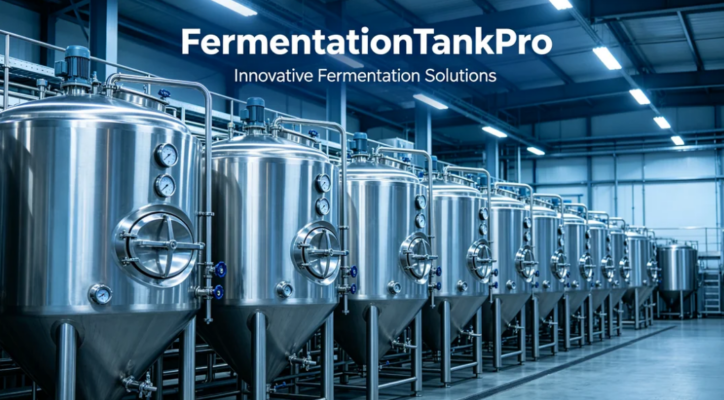
Why Should Buyers Evaluate the Manufacturer’s Engineering Capability?
Engineering capability is important because fermentation tanks must work together with the brewhouse, glycol system, CIP system, piping, controls, and packaging schedule.
A manufacturer with engineering capabilities can help determine:
- Tank quantity
- Tank arrangement
- Cellar layout
- Cooling requirements
- Pipe routing
- Utility requirements
- Control architecture
- Expansion space
- Installation requirements
HGMC states that it combines equipment engineering, manufacturing, and project support, with a manufacturing base exceeding 30,000 square meters and automated laser welding used in equipment manufacturing. The company also states that it has more than 20 years of brewing equipment experience and projects in more than 120 countries.
For buyers, the important point is not simply the size of a manufacturing facility. The practical question is whether the manufacturer can translate the brewery’s production requirements into a workable tank configuration.
What Project Support Should a Fermentation Tanks Manufacturer Provide?
Professional project support should begin before tank fabrication and continue through installation, commissioning, and production.
What Should Be Provided Before Manufacturing?
The manufacturer should confirm the technical requirements before production begins.
Typical project documents and services may include:
- Equipment proposal
- Tank specification sheet
- Process flow diagram
- Brewery layout
- Utility requirements
- Tank arrangement
- Piping concept
- Electrical requirements
- Customized configuration
- Commercial quotation
These documents help the buyer identify potential problems before fabrication.
What Should Happen During Manufacturing?
Production progress should be coordinated against the agreed specifications. This is especially important for international projects where changes become more difficult and expensive after shipment.
Buyers should confirm that the delivered equipment matches the approved technical drawings and quotation.
What Should Be Provided After Delivery?
Installation and commissioning support can reduce the time required to bring the fermentation cellar into stable operation.
Depending on the project, support may include:
- Installation guidance
- On-site commissioning
- Brewing technology training
- Process training
- Equipment operation training
- Troubleshooting
- Spare parts support
- Remote technical assistance
HGMC states that its support includes on-site installation and commissioning, brewing and process training, a three-year tank warranty, and 24/7 after-sales service supported by more than 100 personnel.
Should Buyers Choose a Fermentation Tanks Manufacturer or a Turnkey Brewery Supplier?
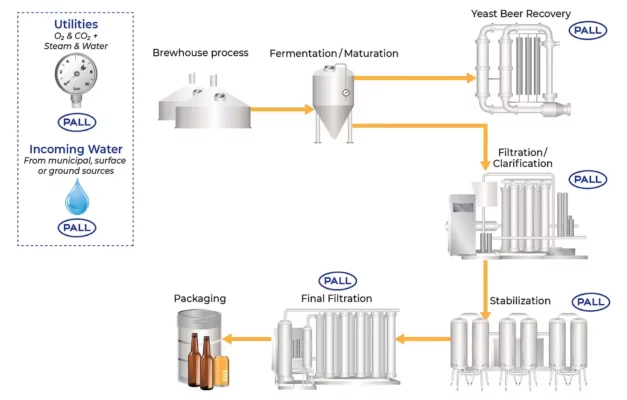
A turnkey supplier can simplify project coordination when fermentation tanks are being purchased as part of a complete brewery. When multiple suppliers are involved, the buyer may need to coordinate brewhouse capacity, fermentation tanks, glycol systems, CIP, piping, controls, and packaging equipment independently.
An integrated supplier can potentially coordinate these interfaces within one project plan.
For example:
Brewhouse → Wort Cooling → Fermentation → Conditioning → Bright Beer → Packaging
The fermentation cellar sits between the brewing and packaging stages. Its capacity therefore needs to be compatible with both sides of the production process.
HGMC describes its capabilities as extending from individual fermentation equipment to turnkey brewing, filling, and packaging solutions.
How Can Buyers Plan Fermentation Tanks for Future Brewery Expansion?
Future expansion should be considered before the first tank is installed because cellar layout and utility planning are difficult to change later.
Buyers should consider reserving:
- Floor space
- Ceiling clearance
- Glycol capacity
- Electrical capacity
- Water supply
- Drainage
- CIP capacity
- Pipe connections
- Control system capacity
- Packaging capacity
For example, if a brewery initially plans six fermenters but expects production to double within several years, the initial cellar layout should ideally consider where additional tanks could be installed.
This does not necessarily mean purchasing all future tanks immediately. Instead, the initial engineering design should leave a practical expansion path.
What Certifications Should Buyers Ask a Fermentation Tanks Manufacturer About?
Buyers should verify which certifications and technical documents apply to the destination market before ordering pressure-bearing fermentation vessels.
Depending on the market and project requirements, buyers may need documentation related to:
- CE
- PED
- UL
- EAC
- SGS
- ISO
- Material certificates
- Pressure testing
- Welding documentation
- Electrical compliance
The exact certification requirement depends on the destination country, tank design, pressure category, volume, and applicable regulations.
HGMC states that it provides international certifications including CE, PED, UL, EAC, SGS, and ISO for relevant projects.
Buyers should request copies of applicable certificates and determine whether they cover the specific equipment being purchased.
How Can Buyers Reduce the Total Cost of Fermentation Tanks?
The most effective way to control total cost is to optimize the entire fermentation system rather than simply choosing the lowest tank quotation.
The purchase cost is only one part of the investment.
Buyers should consider:
Equipment cost + shipping + installation + utilities + maintenance + spare parts + labor + downtime + future expansion
A properly engineered tank may provide better long-term value if it reduces cleaning difficulty, simplifies maintenance, improves temperature control, or integrates more effectively with the brewery’s automation system.
Procurement teams should therefore compare the total project scope before making a purchasing decision.
Why Is Manufacturer Experience Important for Brewery Fermentation Tanks?
Manufacturer experience can reduce project risk because commercial fermentation tanks involve mechanical fabrication, pressure control, sanitary design, cooling, piping, and brewery process integration.
A manufacturer experienced in international brewery projects may also understand that different customers have different:
- Electrical standards
- Building conditions
- Certification requirements
- Installation practices
- Production processes
- Packaging formats
- Utility limitations
According to HGMC’s published information, the company has more than 20 years of brewing equipment experience, serves customers in more than 120 countries, and reports support for more than 5,000 customers worldwide.
For a buyer, the more useful question is how that experience translates into the specific project: technical design, manufacturing quality, documentation, installation, commissioning, and ongoing support.
What Questions Should Buyers Ask Before Ordering Fermentation Tanks?
Buyers should confirm the technical specification and complete project scope before signing the purchase order.
At minimum, ask the manufacturer:
- What is the working and total tank volume?
- What stainless steel grade is used?
- What are the inner and outer material thicknesses?
- What is the tank operating pressure?
- What cooling jacket configuration is included?
- What fittings and valves are included?
- What CIP system is provided?
- What temperature control system is included?
- Can the tank dimensions be customized?
- Can additional tanks be added later?
- What certifications are available?
- What installation support is included?
- What is the warranty period?
- What spare parts are available?
- What after-sales service is provided?
Getting these answers in writing makes it easier to compare different manufacturers objectively.
How Can a Brewery Choose the Right Fermentation Tanks Manufacturer?
The right Fermentation Tanks Manufacturer should combine suitable tank specifications, customization capability, manufacturing quality, engineering support, project experience, and reliable after-sales service.
A brewery should not choose a manufacturer based only on tank price or advertised capacity. The correct decision requires a complete evaluation of production requirements, fermentation cycles, tank quantity, cooling capacity, available space, sanitary design, pressure specifications, automation, certifications, installation, and future expansion.
For small breweries, flexibility and manageable tank sizes may be the priority. For growing breweries, scalable cellar design may be more important. For large commercial breweries, production efficiency, cooling performance, automation, and process integration become increasingly important.
A manufacturer capable of supporting the project from equipment selection through manufacturing, delivery, installation, commissioning, and after-sales service can also reduce coordination between different suppliers.
For breweries planning a new production line, expanding fermentation capacity, or replacing existing tanks, the most useful information to provide a manufacturer is batch size, annual production target, number of brews per week, beer styles, fermentation time, available cellar space, preferred tank capacity, and expected future expansion.
With these details, a professional Fermentation Tanks Manufacturer can develop a tank configuration based on the brewery’s actual production requirements instead of applying a standard package.
FAQ:1. What Is the Best Material for Commercial Fermentation Tanks?
SUS304 stainless steel is a common specification for commercial brewery fermentation tanks because it supports hygienic brewing applications and repeated cleaning when properly fabricated and maintained. Buyers should also evaluate internal finish, welding quality, insulation, cooling jackets, pressure rating, and sanitary fittings rather than selecting the tank based on material grade alone.
FAQ: 2.How Many Fermentation Tanks Does a Brewery Need?
The required number of fermentation tanks depends on batch volume, brewing frequency, fermentation duration, conditioning time, and annual production targets. A brewery producing several batches while previous batches are still fermenting will need enough vessels to prevent fermentation capacity from becoming a production bottleneck.
FAQ: 3.Can Fermentation Tanks Be Customized for My Brewery?
Yes, commercial fermentation tanks can be customized according to production requirements and site conditions. Common customization areas include capacity, diameter, height, cooling jackets, manholes, valves, racking arms, sample valves, CIP connections, pressure components, sensors, and control systems.
FAQ: 4.How Should I Choose a Fermentation Tanks Manufacturer?
Choose the manufacturer by comparing the complete technical and service package rather than the equipment price alone. Check tank capacity, material, pressure rating, cooling system, fittings, customization, certifications, engineering drawings, installation, commissioning, warranty, spare parts, after-sales support, and future expansion capability before placing an order.
Conclusion: What Makes a Fermentation Tanks Manufacturer a Reliable Brewery Partner?
A reliable Fermentation Tanks Manufacturer should provide a complete solution that connects tank design with real brewery production requirements. Capacity, stainless steel construction, cooling performance, pressure control, sanitary fittings, customization, engineering, manufacturing, installation, and after-sales service all contribute to the long-term value of the fermentation system.
For brewery buyers, the most important step is to define the production plan before selecting the tank. Once batch size, brewing frequency, fermentation time, annual output, available space, beer styles, and expansion plans are clear, the manufacturer can recommend the appropriate tank quantity and configuration.
A well-designed fermentation cellar can help breweries maintain stable production, improve temperature control, simplify cleaning and maintenance, and create a practical path for future expansion. For this reason, choosing a Fermentation Tanks Manufacturer should be treated as a long-term equipment and engineering decision rather than a simple tank purchasing decision.
